
How Modern PIM Software Solves the Multi-Supplier Data Problem

Modern Product Information Management (PIM) software solves the multi-supplier data problem by acting as a central system that collects, standardizes, enriches, governs, and distributes product data from many different suppliers into a single, reliable source of truth.
Instead of manually fixing spreadsheets, PDFs, and inconsistent files from each supplier, organizations use PIM to automate normalization, improve data quality, and publish accurate product information to every sales and marketing channel.
This blog explains what the multi-supplier data problem is, why it matters, how modern PIM works, where it is used in real life, its benefits and limitations, and how to implement it step by step.
What Is the Multi-Supplier Data Problem?
Multi-supplier product data refers to product information received from many manufacturers or vendors, each using different formats, standards, naming conventions, and levels of completeness.
Typical supplier data arrives as:
- Excel or CSV files
- PDFs and catalogs
- APIs or portals
- Data aggregators
- Email attachments
- Legacy ERP exports
Each supplier defines attributes differently, making the data difficult to combine.
Why is supplier product data inconsistent by default?
Supplier data is inconsistent because there is no universal product data standard enforced across suppliers. One supplier may call an attribute “Voltage,” another “Input Voltage,” and a third may not provide it at all. Units, formats, and terminology vary widely.
This creates a structural problem, not a people problem.
What is the problem?
- Multiple suppliers send data in different formats
- Attributes are inconsistent, missing, or duplicated
- Manual cleanup does not scale
- Errors propagate across channels
Why Does the Multi-Supplier Data Problem Matter?
The multi-supplier data problem matters because product data is now the primary driver of digital sales, not salespeople or catalogs. When supplier data is inconsistent or incomplete, products become harder to find, harder to compare, and harder to trust—slowing buying decisions and reducing conversion. As suppliers, SKUs, and channels scale, manual fixes collapse under volume, turning data issues into revenue, operational, and customer-experience risks.
Why is this a business-critical issue?
Poor supplier data quality directly impacts:
- Product discoverability
- Conversion rates
- Returns and customer dissatisfaction
- Compliance and regulatory accuracy
- Speed to market
When inaccurate data reaches customers, the business pays the cost.
How does this affect digital commerce and B2B sales?
Digital buyers expect complete, comparable, and accurate product information. When supplier data is inconsistent:
- Filters and search fail
- Product comparisons break
- Marketplaces reject listings
- Sales teams lose confidence in catalogs
Modern commerce requires structured, governed product content, not raw supplier files.
How Modern PIM Software Solves the Multi-Supplier Data Problem
What is modern PIM software?
Modern PIM software is a centralized platform designed to manage product information across the entire lifecycle, from supplier ingestion to channel publication.
Unlike ERP systems that store operational data, PIM is optimized for buyer-facing product content.
How does PIM ingest supplier data?
PIM systems connect to suppliers through:
- File imports (Excel, CSV, XML)
- APIs and feeds
- Manual uploads
- Automated schedules
Supplier data is ingested without forcing suppliers to change how they work.
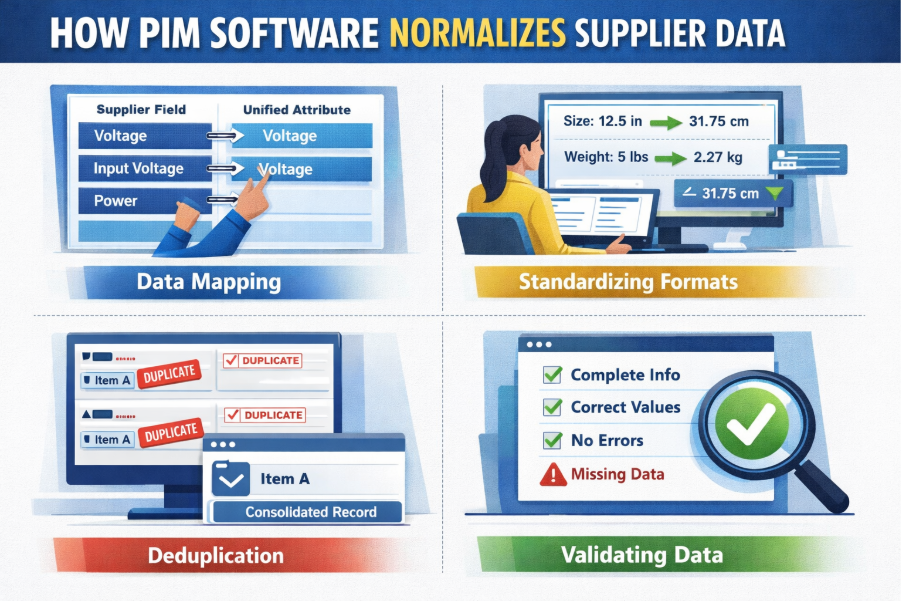
How does PIM normalize supplier data?
Normalization is the core function that solves the problem.
PIM software:
- Maps supplier attributes to a unified data model
- Converts units of measure automatically
- Standardizes naming conventions
- Removes duplicates
- Flags missing or invalid values
This creates a consistent structure across all suppliers.
How does PIM enrich supplier data?
After normalization, PIM enables enrichment by:
- Adding marketing descriptions
- Enhancing technical attributes
- Attaching images, documents, and videos
- Applying SEO-friendly titles and metadata
Enrichment transforms raw supplier data into channel-ready product content.
How does PIM govern data quality?
Modern PIM includes governance features such as:
- Validation rules
- Completeness scoring
- Approval workflows
- Version control
- Audit history
This ensures data stays accurate as suppliers update information.
How do distributors use PIM?
Distributors use PIM to consolidate product data from hundreds or thousands of manufacturers into a single, structured source of truth. PIM allows them to normalize inconsistent supplier attributes, enrich missing data, and maintain accuracy across eCommerce sites, marketplaces, sales tools, and printed catalogs. This reduces manual data cleanup, accelerates SKU onboarding, and ensures buyers see consistent, reliable product information across every channel.
Distributors often manage:
- Tens or hundreds of suppliers
- Overlapping product lines
- Large, attribute-heavy catalogs
Distributors use PIM to consolidate product data from hundreds or thousands of manufacturers into a single, structured source of truth. PIM allows them to normalize inconsistent supplier attributes, enrich missing data, and maintain accuracy across eCommerce sites, marketplaces, sales tools, and printed catalogs. This reduces manual data cleanup, accelerates SKU onboarding, and ensures buyers see consistent, reliable product information across every channel.
Bluemeteor Product Content Cloud helps distributors turn fragmented supplier data into structured, governed, and channel-ready product content. It enables automated normalization, enrichment, and quality controls across thousands of SKUs, while supporting continuous supplier updates.
By centralizing product content management, Product Content Cloud helps distributors scale suppliers and channels without scaling data chaos.
How do manufacturers benefit from PIM?
Manufacturers use PIM to:
- Standardize data from component suppliers
- Create consistent downstream catalogs
- Support partners and resellers
This ensures brand and data consistency.
How do marketplaces rely on PIM?
Marketplaces require strict attribute completeness and formatting. PIM ensures:
- Marketplace-specific data rules are met
- Listings are accepted on first submission
- Updates propagate automatically
Common use cases
- Distributor catalogs
- Manufacturer product hubs
- Marketplace syndication
- Multi-region product launches
Benefits of Using Modern PIM for Multi-Supplier Data
Modern PIM software provides a structured, scalable way to manage product data from multiple suppliers without increasing operational complexity. By centralizing, standardizing, and governing supplier product information, PIM enables organizations to maintain consistent, high-quality product content across all channels. This foundation supports faster onboarding, fewer data errors, and a better buying experience as supplier networks and product catalogs continue to grow.
- Single Source of Truth for Product Content – Centralizes product information from all suppliers into one structured, governed system, reducing duplication, conflicts, and uncertainty across teams and channels.
- Faster Supplier and SKU Onboarding – Standardized data models and automated mappings allow new suppliers and products to be onboarded quickly without manual rework or custom processes.
- Consistent Product Data Across Channels – Ensures the same accurate attributes, descriptions, and media appear across websites, marketplaces, sales tools, and catalogs.
- Improved Data Quality and Completeness – Validation rules and completeness scoring identify gaps and errors before product data reaches buyers.
- Scalable Data Operations – Handles growth in suppliers, SKUs, and channels without increasing manual effort or operational overhead.
- Reduced Manual Work and Errors – Automates normalization, updates, and governance, minimizing spreadsheet-driven processes and human error.
- Better Buyer Experience – Supports search, filtering, comparison, and confident purchasing with reliable, well-structured product information.
How to Implement PIM for Multi-Supplier Data (Step-by-Step)
Step 1: Define a unified product data model
Create a master attribute structure that supports:
- All suppliers
- All channels
- Future growth
Step 2: Map supplier data to the model
For each supplier:
- Map incoming attributes
- Define transformations
- Set validation rules
Step 3: Establish enrichment workflows
Decide:
- Who enriches what
- When approvals are required
- How completeness is measured
Step 4: Integrate downstream channels
Connect PIM to:
- eCommerce
- Marketplaces
- ERP
- Print systems
Step 5: Monitor and govern continuously
Use dashboards and rules to:
- Track data quality
- Catch errors early
- Maintain consistency
Practical Takeaway and Next Steps
The multi-supplier data problem is structural, recurring, and unavoidable as product ecosystems grow. Modern PIM software solves this problem by centralizing, normalizing, enriching, and governing supplier product data at scale.
For organizations managing many suppliers, PIM is no longer optional—it is foundational infrastructure for digital commerce.
Next steps:
- Audit current supplier data quality
- Identify manual bottlenecks
- Define a future-proof product data model
- Evaluate modern PIM platforms designed for complex supplier environments
Clear data structures enable scalable growth. Modern PIM makes that possible.

Related Articles


Recent Post
Categories